A simplified version of this article first appeared in the Lynn News, 12 March 2013
© Anne Morddel 2026
A Prisoner in France
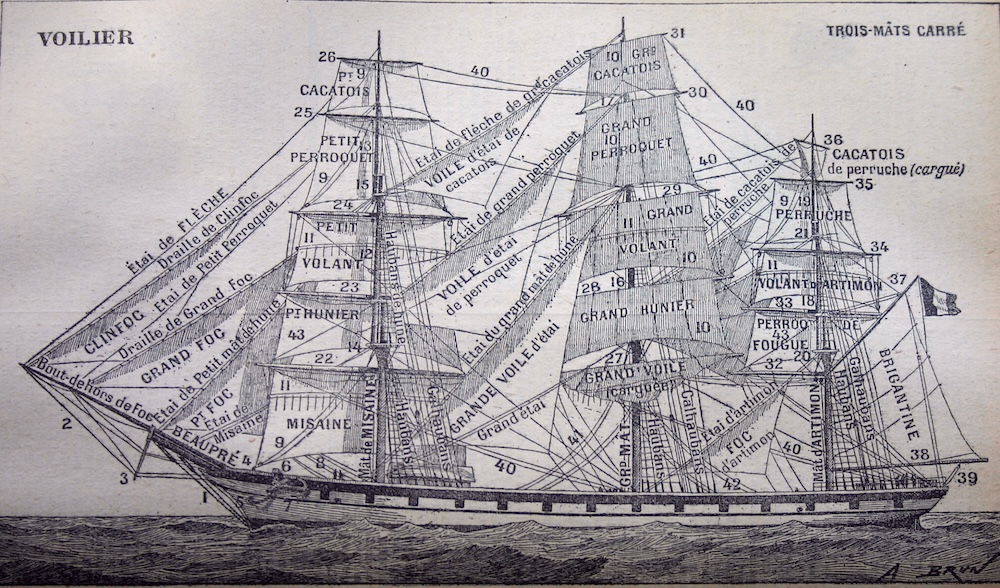
At midday, on the 29th of November, 1810 a young man named Bedford Russell boarded the Flora, a 120 ton[1] brig loaded with timber at Littlehampton bound for Sunderland, in England.[2] Four hours after leaving the harbour, the Flora was captured by a French privateer, the Loup Marin (Sea Wolf in English). Most likely, there was no battle. The Flora had been transporting timber and plank to Sunderland from various ports of Britain for at least a year previously.[3] While the Flora may have had a few weapons and perhaps tried to evade capture, the Loup Marin, (when herself captured a few months later), carried sixteen guns and sixty-four men[4] — a great force. The Flora should have had to strike her colours instantly.
Privateering was a form of piracy sanctioned by a government. Both piracy and privateering involved capturing vessels and selling them and their cargo, e.g. theft at sea. A pirate carried no papers of identity or authorisation. A privateer sailed a privately owned ship and carried letters of marque from his government authorising his activity. A pirate sank or burned a vessel or sold it to any buyer. A privateer could sell a captured vessel only via a court that ruled on the legitimacy of the capture.
The rule was that a privateer could attack only the vessels – merchant-ships and war-ships both – of a nationality with which his own nation was at war.[5] A pirate would attack anybody. If caught, a pirate was hung; a privateer was imprisoned. In the early nineteenth century, Britain, France, the United States, Spain, the Ottoman Empire and just about every government with a port, issued letters of marque to privateers.
The vessels captured were called “prizes”. They were sailed to a port of the capturing or an allied country and valued. The cargo and vessels were sold and the proceeds divided up among the government, the privateer and any partners, and the ships’ crews. Of those individuals captured with the vessels, the crew were considered as prisoners of war; the passengers had to prove that they were merely taking passage and were in no way serving the war effort of the enemy nation.[6] A hefty amount of bargaining and trading of individuals back and forth went on between governments concerning the more valued prisoners.
During the Napoleonic Wars (1803-1814), privateering was vigorously pursued by all combatants and was a highly lucrative way for individuals to show their patriotism. The prisoners of the French had the additional onus to prove not only that they were not serving on the crew of an enemy vessel, but that they were not themselves British. This was because, in 1803, as soon as war was (yet again) declared with Britain, Napoleon had issued the Decree of 22rd May, 1803 (2 Prairial An XI in the Republican Calendar then in use) which ordered that all British men between the ages of 18 and 60 then in France or her territories be detained as prisoners of war, on the grounds that by British law, all were eligible to serve in the militia and were, in theory at least, potential enemy soldiers. Thus, everyadult British male was, if captured, a prisoner of war.[7]
The Loup Marin was captained by Le Croisy. On the First of December, he led the Flora and another prize he had taken, the Olive Branch, into the French port of Dieppe.[8] The Flora’s timber would have been sold by the Prize Commission[9] and he would have been a richer man. The crew most likely were treated as prisoners of war. Bedford Russell said he was an American from Boston, but he had to prove it.[10] When he arrived in Dieppe, he was sent to the prison, a massive stone fortress built in the twelfth century called the Chateau de Dieppe.
After two weeks in prison, Bedford Russell was finally interrogated by the police commissioner, one Louis Marie Baudelicque, and the two pages of questions and answers, all in the French translation, survive in the file on Bedford Russell in the French military archives at the Service Historique de la Défense in Vincennes, outside of Paris.
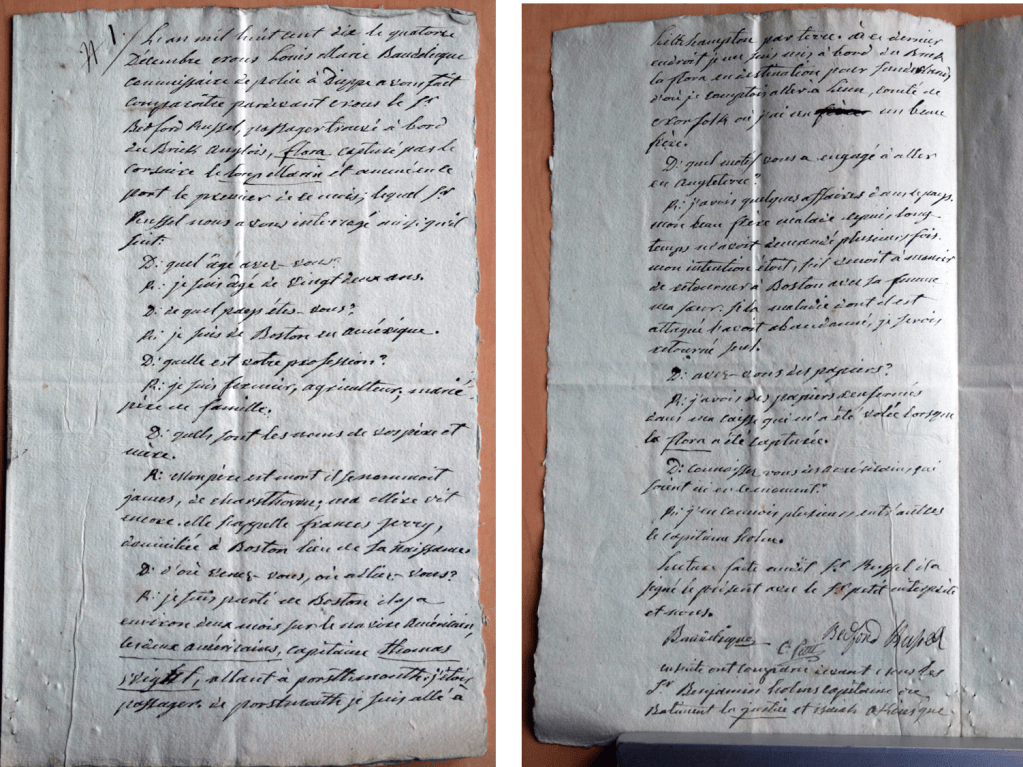
Interrogation of Bedford Russell
In response to the questions, Bedford said that he was 22 years of age and from “Boston in America”. He was a farmer, married, a father of children. He was then asked the names of his parents. “My father is dead. He was named James from Charlestown; my mother is still alive. Her name is Frances Jerry and she lives in Boston, where she was born.”
“Where were you coming from and where were you going?” Baudelicque asked.
“I left Boston about two months ago on the American ship, the Two Americans, Captain Thomas Wight, going to Portsmouth. I was a passenger. From Portsmouth I went to Littlehampton by land. There, I boarded the brig Flora, going to Sunderland. From there, I was planning to proceed to Lynn, in Norfolk County, where I have a brother-in-law.”
When asked what he was doing in England, he said he had business in the country. He also said his brother-in-law had not been well for a long time and had many times asked him to visit. “My intention was, if he were to die, to take his wife – my sister – back to Boston. Should he recover, I was to return to Boston alone.”
Baudelicque asked if he had any papers. “My papers were in a locked box which was stolen from me when the Flora was captured.” Baudelicque asked if he knew any Americans who might be in Dieppe at the moment who could vouch for him. “I know many, among them Captain Holmes,” Russell replied.
That was the end of the interrogation. Both Baudelicque and Russell signed it, as did a C. Petit, (unidentified but who was probably the secretary or interpreter). Below the signatures and possibly after Russell had left the room, the document continues and goes on for another half page, stating that Mr. Benjamin Holmes, captain of the ship Justice, and Isaiah Atkins were brought in. Both were known to Baudelicque to be “subjects of the United States of America” and to reside in Boston. Both men declared and affirmed that Mr. Russell was truly of Boston. Baudelicque, Petit, Holmes and Atkins all signed. There is no signature for Russell on this second part.[11]
There are two notes on small scraps of paper in the French file, testimonials of a sort, confirming that Bedford Russell was American. The first is signed by William Patterson, master, and Richard Harrison, mate:
I do hearby Certify that Mr. Bedford Russell Came on Bord of my Ship at Portsmouth out of the Two Americans Captain William Bright witch Brought him passenger from Boston and he informed me that He is a farmer in Chalston Near Boston and never before from his hoome, he came on Bord of me passanger for Conveyanancey of his Lugge at 12 oClock on the Friday and Was taken at four the same afternoon Wich he remained only 4 hours on Bord of my ship. I allso can say that his friends is Wall known By my mate Wich sailed six years out of Boston.[12]
The second note is from John Actkins and William Hoomes:
I Willim Hoomes and John Actkins belonging to Boston in America state of massachicet Do here By Certify that Mr. Bedford Russell was a passenger On Bord the english Brig flora and I allso can say that Whe Wall now him to be a farmer in Chalston Near Boston in a farme Near Mr Willm Gray marchant.[13]
Bureaucracy moves ever slowly and, while Bedford waited in one of the damp cells of the Chateau de Dieppe, the Ministries of Police and War were exchanging correspondence about him. The Duke of Rovigo, intensely loyal to Napoleon and notorious for running the Ministry of Police like a “veritable inquisition”,[14] had already determined that Russell, though American, having been on an English ship was to be treated as a prisoner of war. However, he wrote to the Duke of Feltre, the Minister of War, for his opinion, for there were “particular circumstances”.[15] The particular circumstances concerned Russell’s name and possible relations. It was not assumed that he was in any way related to the powerful, British Russell family and the Duke of Bedford, but that he was related to Jonathan Russell, who had just been appointed by President James Madison as chargé d’affaires to the American legation in Paris.[16]
One of the many responsibilities of the staff of the American legation at that time was to try to secure the release of American sailors who had been taken prisoner by France. The Quasi-War between the two countries having ended ten years earlier, France was not then at war with the United States, which was neutral in 1810. Even so, privateers took American ships that had called at British ports, on the grounds that they aided the enemy’s commerce, and imprisoned their crews and passengers. American sailors who had been pressed by British ships that were then captured were also imprisoned and — their papers and seaman’s certificates usually being confiscated when they were impressed — had an extremely difficult time proving their nationality. Generally, the French authorities would accept the word of a member of the American legation as to the nationality of a prisoner claiming to be from the United States.
In late December, a new prisoner arrived in the Chateau de Dieppe. D’Arcy Boulton was a fifty-year old lawyer who was, at the time of his capture by the French, His Britannic Majesty’s Solicitor General for Canada and a resident of Quebec. He described how he was placed in “Common Goal without Bed or Fire with the lowest of Prisoners and … even prevented getting the common necessaries of Life.”[17] One of those “lowest of Prisoners” may have been Bedford Russell, for he prevailed upon Boulton to write more than one letter to Jonathan Russell on his behalf.[18]
Apparently, Boulton’s letters brought positive results, for Jonathan Russell seems to have sent a short note to the Duke of Rovigo on the Second of January, 1811 to say that he had seen a copy of the interrogation, independent of which he had “sought other proofs and [was] fully persuaded that the said Russell is truly a citizen of the United States” and asked that “Your Excellency therefore give the orders necessary for his liberation.” The note does not appear in the French file on Russell, but a copy of it is among the papers of Jonathan Russell, with no indication that it was not sent.[19] If it was, the Ministry of War did not know of it and, on the 17th of January 1811, determined to send Russell to the prison at Cambrai, insisting that he was an enemy sailor and not a passenger.[20]
Prisoners usually were marched, sometimes in chains, from the coast to the various prisons around France. The distance from Dieppe to Cambrai is nearly one hundred miles. Perhaps Russell was informed of the decision concerning him, for he took his own mad, brave and exceedingly dangerous decision to escape. On the 11th of February, inexplicably having managed to get hold of a number of bridles to use as ropes, he lowered himself out of a window of the Chateau de Dieppe and disappeared into the night. The commandant who had the unhappy job of reporting Russell’s escape to the Minister of War said that, “since Russell said he is related to the head of the American legation in Paris, from whom he has sought protection, it is possible that he will try to go to Paris.”[21]
Russell stayed hidden for a week, no record shows where. Somehow, he made arrangements for and promised a fisherman, Mr. David, one hundred guineas to take him to “any English boat in the Channel”. One night, he hid in the bottom of Mr. David’s fishing boat for four hours, and that is where the police found him.[22]
Recaptured, Bedford Russell made the march to Cambrai, as his transfer paper shows, leaving Dieppe on the 9th of March, 1811. He is clearly listed as a native of Boston and as a passenger.[23]
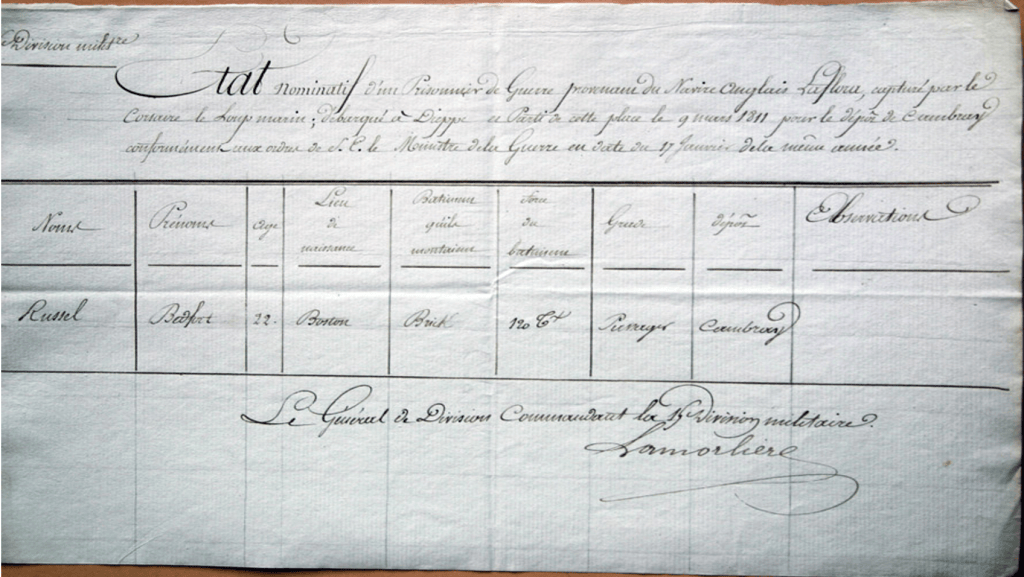
Bedford Russell Transfer from Dieppe to Cambrai
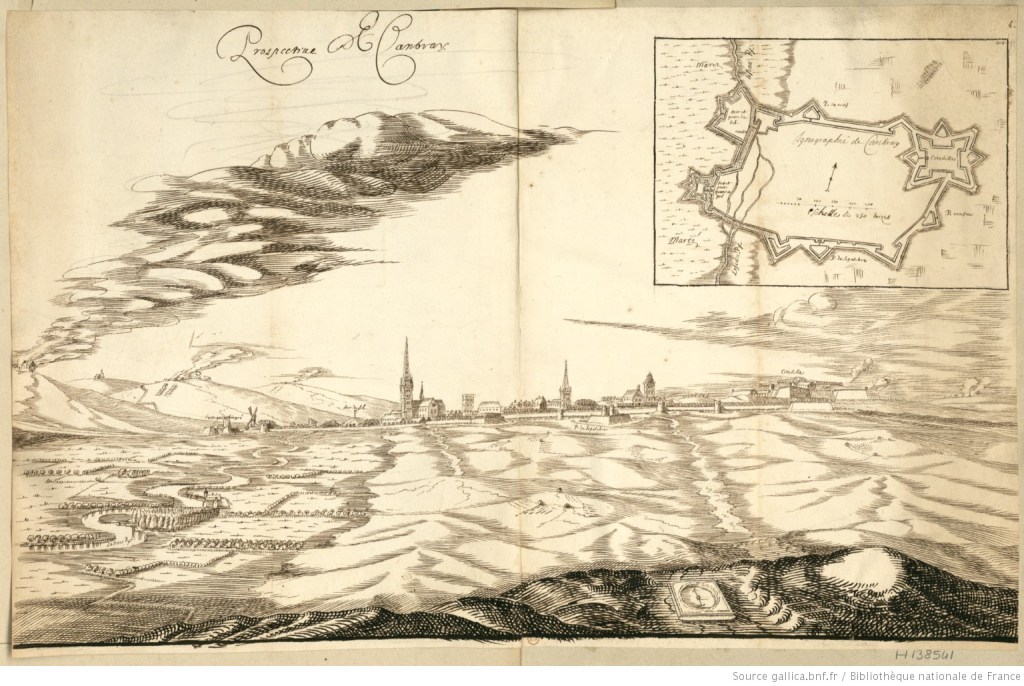
Of the prisoner depot at Cambrai, Michael Lewis writes in Napoleon and His British Captives: “It was not established…until 1809, but it then became one of the larger prison centres. Its reputation among the British was always fairly good.”[24]
D’Arcy Boulton was also sent to Cambrai. On the 22nd of March, while there, he wrote again to Jonathan Russell on Bedford’s behalf, saying “There can be no doubt [that he is an American] I know him myself, I am well acquainted with the Rev. Dr. Gardiner of Boston, whose parishioner this gentleman is.” He also mentions the fact that Bedford Russell’s wife was a “young Canadian woman.”[25] No further correspondence from Jonathan Russell about Bedford Russell has been preserved in French archives or in the papers of Jonathan Russell. Boulton soon was transferred to another prison.[26]
Those prisoners who attempted escape were treated harshly. Invariably, a recaptured escapee was transferred to the prison in the fortress at Bitche, far to the east. Bitche was a place dreaded by all. The fortress, another of thick stone, had been dug deep down into the hill on which it stood, and many of its prisoners endured life in underground dungeons. Lewis says “Here conditions of imprisonment were at their worst…..Every Briton who went there….was daunted by the grimness of Bitche.”[27]
With his escape attempt, Bedford lost any sympathy the authorities may have had for him. The Duke of Rovigo wrote that he was a “seductive fellow” who had corrupted a French citizen during his brief liberty.[28] The Minister for Marine Affairs chimed in and wrote that since he had escaped from Dieppe, he should under no circumstances be released.[29] The Duke of Feltre wrote to the Commandant of Cambrai to watch Russell carefully and, if he showed any signs of being a troublemaker or of planning another escape, to send him to Bitche immediately.[30] In it, the Commandant of the prison at Cambrai agrees to watch Russell closely.
With other British prisoners, he was put to work. Sometimes, they worked,
under heavy guard, outside the prison walls, well into the night. On the 19th of May 1811, at 11 o’clock at night, Bedford snuck away. The alarm was raised. The gendarmes searched every house in Cambrai. The guards at all entries to the city were alerted. They did not find him and the sergeant on guard when he escaped was demoted. He turned up some months later, having made it to the Atlantic coast of France, where he was recaptured. He was sent to the seriously overcrowded prison for forced labour at Brest.
Bedford Russell’s story is filled with precise personal details: the names of his parents, his and his mother’s places of birth, his marital status, his wife’s nationality. There are local details: merchants and a church leader in Boston. Finally, there are his travel details and the fact that he had a sister in Lynn. None of it was true, as the research in U.S. records will show.
Boston
The search for Bedford Russell in Boston begins with the 1810 census. That census was begun on the first Monday in August of that year[31] and it reasonable to expect that, were he the head of his household, he might have appeared, for he did not travel until roughly two months later. There are 32 households in Middlesex County, Massachusetts, where Charlestown is located, that were headed by someone of the surname of Russell; no one is named Bedford Russell.[32]
In Charlestown itself, there are four Russells, one of them a James.[33] Could he have been Bedford’s father? It was certainly possible for him to have died in the weeks between the census enumerator’s visit and Bedford’s departure for England. Within it, the household contains two white males aged between 16 and 25, one of whom could have been the 22-year-old Bedford. There is also one white male aged 45 or over, who should have been James Russell; and there is one white female aged 45 or over who could have been Bedford’s mother, Frances. There is a female aged between 16 and 25 who could have been Bedford’s Canadian wife, and there are three children under the age of 16 one, two or all of whom may have been Bedford’s children.
In the 1820 census for Middlesex County, there is no James Russell; he could have died or moved house. However, a search of the Middlesex County, Massachusetts Probate Index[34] for the years 1810-1812 shows no will for a James Russell, who would have had to have died in the second half of 1810, in order to fit with Bedford’s details. This could mean that he died intestate, or that his will was not recorded, or that this man did not die during that time. The same index does show a James Russell of Charlestown who died in 1801, when Bedford would have been aged 13, but a search of that database brings no Frances Russell, Frances Jerry or, (taking into consideration that the French recorder of the name may have put the French letter that is pronounced “zhay”, which is G), Frances Gerry, as administrator or guardian. Thus, the Probate Index provided no way to link Bedford with any James Russell of the 1810 or 1820 Charlestown census.
An anonymously published genealogy, An Account of the Russell Family of Charlestown, gives the names of the children of two men named James Russell, (neither of whom married a Frances) including one who was a Loyalist who removed to England, but there is no Bedford.[35]
In fact, diligent searches of numerous publications, records, collections and indices via the online databases at Ancestry.com, AmericanAncestors.org, FamilySearch.org, Footnote.com, etc. bring no Bedford Russell in Massachusetts, son of James Russell and Frances Jerry, nor any marriage of a James Russell to a Frances of any surname within a reasonable time frame for them to be the parents of Bedford.
Wider searches brought one Bedford Russell, justice of the peace, in Groton, Middlesex County in 1838,[36] but his name turned out to be a mistaken transcription of the name Bradford.[37] Another Bedford Russell was born in Ontario in about 1847 of an English father.[38] Could this have been a late in life son of our Bedford Russell? No, for his parents were both born in England, whereas our Bedford’s wife (and the mother of any son of his) was Canadian. Could this son be the fruit of a second marriage to an English woman? There is no way to know and, in any case, this man’s father’s name was William born in 1810,[39] not Bedford born in approximately 1788. Tracing Bedford Russell in Charlestown, Massachusetts was proving fruitless.
Turning to his mother, there is no Frances Russell, widow, in either Charlestown or Boston in the 1810 or the 1820 census. Perhaps she was living with family? If with a married daughter, the name would not be known, but perhaps with someone of her own family? There are no Jerry or Jarry households in the state of Massachusetts in the 1810 or the 1820 census. There are, however, four households in Boston with the surname of Gerry in 1810 and three in 1820. There was a ray of hope of finding her on reading in a small footnote in a book by Henry F. Waters, the 1892 New England Historical and Genealogical Register, in which he wrote that “The families of Russell, Greenleaf and Gerry were connected…”[40] However, he did not elaborate. Perhaps she remarried? There are no records of a Frances Russell, widow, marrying in Boston or Charlestown during the time of 1810 to 1820. Finding Frances (Jerry) Russell of Boston was unsuccessful.
Was Bedford Russell connected to Jonathan Russell? The latter, of the American legation in Paris in 1810, was born in Rhode Island, but he was descended, on his father’s side, “from John Russell, a 1640 resident of Charlestown, Massachusetts.”[41] Even though he makes no mention in his note to the Duke of Rovigo of Bedford Russell being any kind of kin, and though Bedford himself said nothing of the relationship in his original interrogation, perhaps there was a connection. But no, or if so, it is not documented. The published genealogy of the descendants of that early John Russell does show Jonathan Russell[42], but no Bedford. Neither are there any who married into that family who had the surname of Gerry, Jarry or Jerry. It would seem that Bedford Russell was no relation to Jonathan Russell.
Yet, negative search results do not make a certain answer. Not finding Bedford and his parents in surviving documentation of Massachusetts does not necessarily mean that they were not there. Many documents have not been preserved. Additionally, the mobility of people — travel during a census, marrying out of town, dying inconveniently, moving on leaving no trace – meant that people often escaped full documentation.
Bedford Russell had rather specific knowledge of Charlestown and Boston, the knowledge of a local. D’Arcy Boulton wrote that Bedford was a “parishioner of the Reverend Dr. Gardiner.” This is possible, for John Sylvester John Gardiner was the rector of Trinity Church in Boston in 1810. Yet, a query to the archivist at Trinity Church brought the response that no Bedford Russell married in the church. In fact, there were no Russells named James, Frances, or Bedford among the church’s parishioners from 1808 to 1820.[43]
One of the testimonials quoted above mentions the merchant, William Gray, as a neighbour. This too is quite specific and is possible. In 1810, William Gray was the lieutenant governor of the state of Massachusetts.[44] Originally from Salem, he was a very, very wealthy man, the owner of 60 vessels and of a large wharf, (but not his home), in Charlestown.[45]
Incidentally, a biography of William Gray lists all of the vessels that he owned. None of them is named Two Americans, the ship on which Bedford Russell sailed from Boston. Indeed, no such ship appears in any reference work or newspaper available via the internet. Two Brothers, Two Sisters, Three Brothers, Four Sisters etc. were common names for vessels, but Two Americans cannot be found. Nor can a Captain Thomas Wight with any connection to a Two Americans be traced.
In the end, but for the names of the cities of Boston and Charlestown and the names of three men who lived there: James Russell, William Gray and the Reverend Dr. Gardiner, nothing about Bedford Russell could be verified, not even any possible connection between him and those cities and men. The research from the Boston point of view brought nothing.
England
Bedford Russell said during his interrogation that he had arrived in Portsmouth from Boston and then travelled by land to Littlehampton. Lists of alien arrivals in England exist for the year 1810. There were 94 people from the United States who arrived at various English ports, including Portsmouth, between August and the 31st of December, 1810.[46] None of them had the surname of Russell by any spelling.
Bedford also said he had business in England, but he did not say of what nature or where, giving no clue with which to begin research. He said that he had a married sister in Lynn, but he gave neither her nor her husband’s name nor any information about them at all, except that the husband was unwell.
Lynn
The town of Lynn and Bedford Russell’s sister and brother-in-law were the last possible clues to pursue. Perhaps the sister had married in Lynn and not in Charlestown? Perhaps Bedford or James or Frances had been there before and for long enough to appear in a record? There seemed very little chance of finding him, and nowhere else to look.
And there he was.
Looking into the parish baptism records for St. Margaret, Lynn revealed many Russells but no Bedford. Within the parish was St. Nicholas Chapel, with its own register of baptisms, marriages and burials, and Charles Baggs was the minister at both churches. No Bedford Russell was baptised in St. Nicholas Chapel. There was one boy named Bedford born in July, 1782. He was illegitimate. His mother’s name was Frances Jeary.[47]
Bedford was his mother’s second illegitimate child. Her first, whose baptism appears a few pages earlier in the same register, was James, born in October, 1779.[48] The marriage register for St. Nicholas reveals that, when Bedford was a year old and James was four, their mother married a widower named James Russels.[49] The couple then had two more children, George, born in October of 1784,[50] and Charles, born two years later.[51] James Russels, Bedford’s father, then died and was buried on the 29th of October, 1786, when Bedford was four years old.[52] His mother had one more child marked in the register as illegitimate, Mary, born in August, 1789[53], three years after the death of James.
Frances Jeary’s older sons, James and Bedford, used the surname Russell. In April, 1804, at the age of 21, Bedford Russell married Mary Nowell in the parish of St. Margaret, Lynn.[54] Bedford was noted as “of this parish” in the register, as was Mary. She was not noted as being from Canada. They had two children: Elizabeth in January, 1805 and George Bedford a year later. Both were baptised in St. Margaret.[55]
Could it be that the prisoner in France lied? If so, which part or parts of his story are the lie? If he were the Bedford Russell of Lynn, whose story matches in terms of parents’ names and civil status, and in terms of having a sister, a wife and children, then all he said about his life in Massachusetts and his Canadian wife was a lie. Yet, how did he come by such detail about Boston? If he were from Massachusetts, how is it that there is no trace of him or his parents among the Russell and Gerry families of Massachusetts? Was he a Massachusetts man who, while in England, met and then borrowed the identity of Bedford Russell? If so, then how did he get such an upstanding gentleman as the Solicitor General for Canada to lie for him?
Once the possibility of falsehood is introduced, every supposed fact and detail becomes suspect. Documentation, even from parish records, government ministries, police, ambassadors, solicitor generals, and prison camp commandants, cannot automatically be taken as certain truth. It must be examined much more closely.
Re-examining the Documentation
Going back to the original documentation, the French all seem to accept that Bedford Russell was American. Most accepted that he was a passenger and not a member of the crew. They wondered if he might not have been a relative of Jonathan Russell but, after his escape attempt, they were in agreement that he was not to be trusted. The documents about his movements between prisons, about his escape and recapture all agree with one another and seem straightforward reports of activities.
Among the documents from Americans or Britons, those which stand out as most suspect are the two small notes that seem to be testimonials. The note signed by Patterson and Harrison is dated the 29thof November, 1810, the day the Flora was captured and two days before she entered Dieppe harbour as a prize. The note signed by Hoomes and Actkins is dated the following February, three days after the escapee Russell was found crouched in the bottom of a fishing boat.
The notes would appear to have been written by the same hand; the phrase “Chalston Near Boston” particularly seems identical in the two notes:
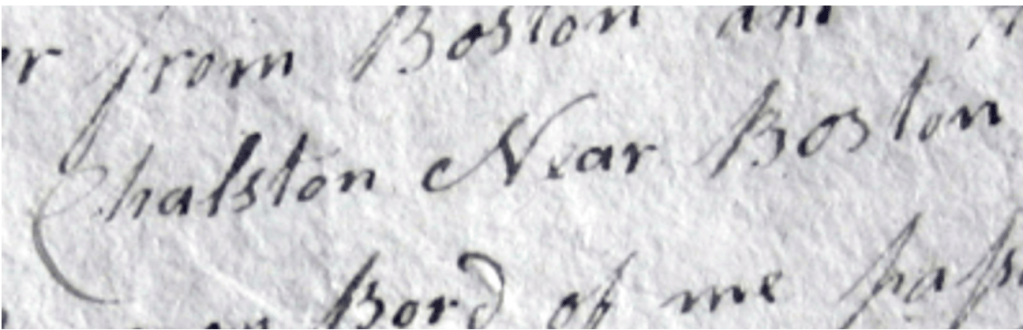
Patterson-Harrison note
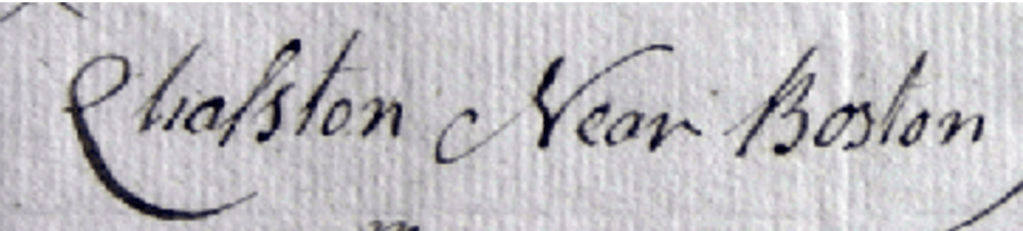
Hoomes-Actkins note
There are discrepancies between one or the other of the notes and other sources.
In the Patterson-Harrison note, the captain of the Two Americans is named as William Bright; in Bedford’s interrogation, the name was Thomas Wight.
In the Patterson-Harrison note, it is said that Bedford Russell boarded the Flora at Portsmouth; whereas the ship was never in Portsmouth, but sailed from Littlehampton. In his interrogation, Bedford said he went by land from Portsmouth to Littlehampton. Surely a captain would not mistake his port of departure?
In shipping announcements in the “Tyne-Mercury” for 1809-1810, the name of the captain of the Flora is consistently spelt Pattison, not Patterson[56].
In both notes, two words have been written as they would have been pronounced with a Norfolk, England accent: hoome for “home” and Hoomes for “Holmes”. (The Norfolk accent, including cases of this pronunciation of “home”, can be heard in a British Transport film on YouTube, entitled “East Anglian Holiday (1954) – extract”.[57])
The authors of the Hoomes-Actkins note clearly are meant to be the Captain Benjamin Holmes and Isaiah Atkins who affirmed that Bedford Russell was “truly from Boston” on his interrogation document. Aside from their names being incorrect, the signatures on the note and on the interrogation bear no resemblance to one another at all.
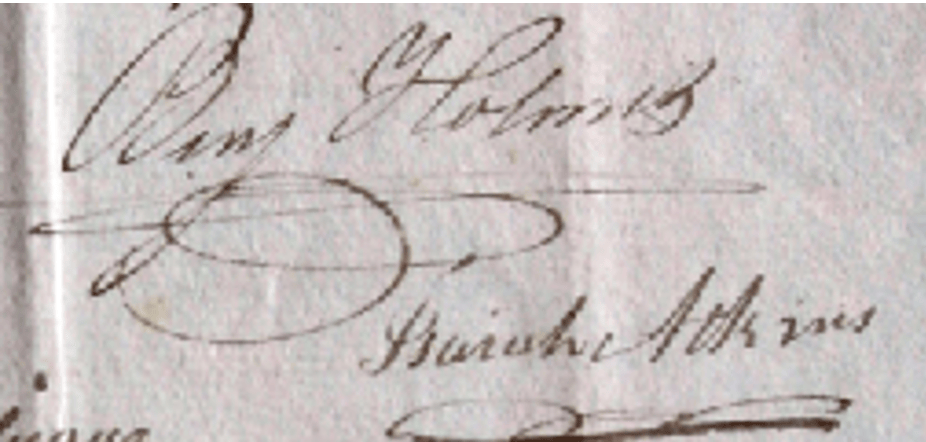
Signatures of Benjamin Holmes and Isaiah Atkins
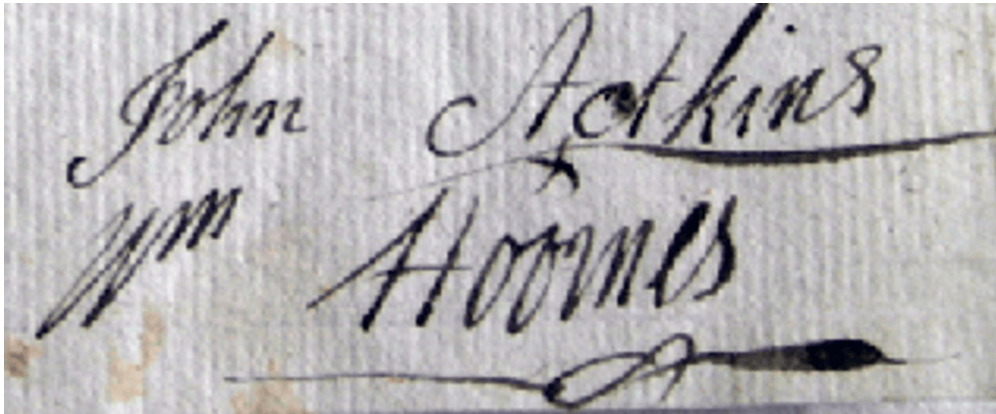
Signatures of John Actkins and William Hoomes
It seems most likely that Bedford Russell wrote these two testimonials himself, (having become somewhat befuddled as to details) probably to show to either Jonathan Russell or D’Arcy Boulton, or to both, as proof of his being from Boston. If so, it is baffling that both of these educated and worldly men could have been duped by an East Anglian pretending to be a Bostonian. There were hundreds of British prisoners attempting the same sort of ploy. Jonathan Russell was new on the job and perhaps not yet fully aware of their many ruses. Nevertheless, whether their judgement of Bedford Russell’s nationality was formed based on these two notes or on other documentation which has not survived, there is no record that Russell or Boulton altered their opinion.
One of the testimonial notes could provide a clue as to how a man who had never been to Boston could have learned a few crucial details about the place. The Patterson-Harrison note mentions that Richard Harrison, the mate of the Flora, “sailed six years out of Boston”. A clue from a forged note should not be given great credence, but may merit some consideration. Harrison may have been imprisoned with Bedford Russell during those first two weeks before the police interrogation, and he may have schooled him in some details of Boston. Additionally, there could have been any number of others in the prison who were from Boston.
Re-examining the parish registrations of St. Nicholas Chapel and St. Margaret in Lynn, there seems to be no evidence of tampering, nor does there seem to have been any evident reason for the Reverend Baggs to have lied. In fact, he seems to have been rather rigid about adhering to the truth, at least where bastardy was concerned.
All in all, the evidence very strongly points toward the prisoner in France not being a citizen of the United States or from Boston at all, but to his being Bedford Russell of Lynn, Norfolk, England. In 1810, that Bedford Russell was aged 28 (not 22, as he told the French police), married, with two small children; he was the son of James Russels and Frances Jeary. Perhaps it really was his first time from home, as one of the notes said. Perhaps his sister really did have an ailing husband he was travelling to visit. When the Flora was captured, perhaps his case containing his papers was stolen or perhaps, knowing that to be British meant certain imprisonment, he threw it overboard, a not uncommon thing to do in such circumstances.
Then he told a pack of lies. He did not lie about everything. What he gave as information about his family is supported by documentation in Lynn. What he gave in terms of place of origin in Boston and Charlestown and about his travel from the United States, cannot in any detail be supported by any record or document other than his own interrogation and two scraps suspected of being written by Bedford himself.
Bedford Russell would seem to have been a determined and opportunistic man who altered his story to suit the listener. He convinced the French at Dieppe that he was related to the American chargé d’affaires. He convinced two Boston men, Holmes and Atkins, that he too was from Boston. He convinced two highly educated North American government officials, D’Arcy Boulton and Jonathan Russell, that he was from Boston, and one of them also that he had a Canadian wife. Then again, perhaps he convinced no one but somehow inspired great compassion in them all, compassion enough for them to lie for him. He even managed a quite daring – or desperate, if foolish, escape from prison and almost from France.
When the First Empire fell in 1814, thousands of British and American prisoners of war were released had to make their way from the prisoner depots of Bitche, Verdun, Valenciennes, Longwy, Arras, Cambrai, Givet, Metz, Sarrelibre and many more to the coast, where they could take ship home. Bedford Russell probably was still doing forced labour at Brest when the release order came. Happily, he made it home.
In 1820, he was working as a bailiff under George Samuel Kett, esquire, Sheriff of Norfolk.[58] The 1841 England census for Lynn shows a Bedford Russall, aged 55, in the parish of St. Margaret. He is still married to Mary, aged 60. A little girl, Mary, aged three, lives with them.[59] The census form says that he was born in Norfolk County, (not Boston, Massachusetts). He lived with Mary until her death in 1843.[60] They seem to have had no more children. He appears in the King’s Lynn 1851 census, a widower, aged 68, living with his housekeeper, Elizabeth Cook, and five-year-old granddaughter, Dorah.[61] Five years later, he married his housekeeper[62] in the parish of St. John, King’s Lynn, giving the name of his father as “James Russell, publican”[63]. He died at the age of about 80 in the summer of 1862.[64] Henry J. Hillen, in his History of the Borough of King’s Lynn, said of him that “to the end of his days, Bedford Russell, of Union Street, the sheriff’s officer, was indeed a terror to evil doers.”[65] Perhaps he learned a few tricks of the trade in French prisons?
*I would like to thank the members of the Norfolk Mailing List on rootsweb for their many helpful suggestions.
[1] Gazette nationale ou Le Moniteur Universel. No. 347, 15 Dec 1810. Paris. p.1.
[2] Document dated 29 November, 1810. File entitled, Russel, Bedford. Prisonnier de guerre Anglais, 1er Empire. Carton Yj69. Service Historique de la Défense, Chateau de Vincennes, Paris.
[3] “Tyne-Mercury Extracts”, 14 Feb, 9 May, 16 May, 20 June, 11 July, 22 Aug, 12 Sept, 26 Sept, 12 Dec, 1809; (http://www.englandspastforeveryone.org.uk : accessed 28 Dec. 2010.)
[4] Nichols, John. The Gentleman’s Magazine and Historical Chronicle. January-June, 1811. Vol. 109. London : John Nichols & Son, 1811. p.271.
[5] Barclay, Sir Thomas. “Privateer”. The Encyclopaedia Britannica, Eleventh Edition. New York : The Encyclopaedia Britannica Company, 1911. Vol. 22, p. 370.
[6] Barclay, Sir Thomas, “Prize”. Op Cit., vol. 22 p. 373.
[7] Gazette nationale ou Le Moniteur Universel. Op. Cit. no. 244, 24 May, 1803, p. 1106, column 1.
[8] Gazette nationale ou Le Moniteur Universel. Op. Cit. No. 347, 15 Dec 1810. Paris. p.1.
[9] Disappointingly, it is not possible to know the value of the Flora and her cargo, for the entire archives of the Prize Commission, Le Conseil des prises, was burned during the Paris Commune in 1871.
[10] Numerous documents in the file entitled, Russel, Bedford. Prisonnier de guerre Anglais, 1er Empire. Op. Cit.
[11] The copy of the interrogation of Bedford Russell sent to the Ministry of War in the file entitled, Russel, Bedford. Prisonnier de guerre Anglais, 1er Empire. Op. Cit.
[12] Note dated 29 Nov 1810, Dieppe, in the file entitled: Russel, Bedford. Prisonnier de Guerre Anglais, 1er Empire. Op. Cit.
[13] Note dated 23 Feb 1811, Dieppe, in the file entitled: Russel, Bedford. Prisonnier de Guerre Anglais, 1er Empire. Op. Cit.
[14] Rose, John Holland. “Savary”. The Encyclopaedia Britannica, Eleventh Edition. New York : The Encyclopaedia Britannica Company, 1911. Vol. 24, p. 241.
[15] Document dated 17 December, 1810, from the Minister of Police to the Minister of War War in the file entitled, Russel, Bedford. Prisonnier de guerre Anglais, 1er Empire. Op. Cit.
[16] “Russell, Jonathan”. Mitchell, Martha, ed. Encyclopedia Brunoniana. Brown University Library, 1993. Online entry: (http://www.brown.edu/Administration/News_Bureau/Databases/Encyclopedia/search.php?serial=R0310 : accessed 30 December, 2010)
[17] Letter from Boulton to the Duke of Feltre, dated 4 March, 1811 in the file entitled, Darcy Boulton. Prisonnier de guerre Anglais, 1er Empire. Carton Yj69. Service Historique de la Défense, Chateau de Vincennes, Paris.
[18] Ms. no. A5545. The Papers of Jonathan Russell, 1771-1832. Hay Manuscripts. Brown University Library, Brown University, Providence, Rhode Island. Digital reproduction sent by e-mail
[19] Ms. no. A5110. The Papers of Jonathan Russell, 1771-1832. Hay Manuscripts. Brown University Library, Brown University, Providence, Rhode Island. Digital reproduction sent by e-mail.
[20] Internal Ministry of War document dated 17 January 1811 War in the file entitled, Russel, Bedford. Prisonnier de guerre Anglais, 1er Empire. Op. Cit.
[21] Letter dated 17 February, 1811 in the file entitled, Russel, Bedford. Prisonnier de guerre Anglais, 1er Empire. Op. Cit.
[22] Bulletin du 23 février, 1811. La Police Secrète du Premier Empire. Code F7/3770 Archives nationales, Paris, France.
[23] Prisoner transfer paper for Bedford Russell, dated 9 March, 1811 1811 in the file entitled, Russel, Bedford. Prisonnier de guerre Anglais, 1er Empire. Op. Cit.
[24] Lewis, Michael. Napoleon and His British Captives. London : George Allen & Unwin, 1962. p.158.
[25] Ms. no. A5545. The Papers of Jonathan Russell, 1771-1832. Hay Manuscripts. Brown University Library, Brown University, Providence, Rhode Island. Digital reproduction sent by e-mail.
[26] Numerous documents in the file entitled, Darcy Boulton. Prisonnier de guerre Anglais, 1er Empire. Op. Cit.
[27] Lewis, Michael. Napoleon and His British Captives. Op.Cit,, p.142-3.
[28] Letter from Rovigo to Feltre dated 26 March 1811 in the file entitled, Russel, Bedford. Prisonnier de guerre Anglais, 1er Empire. Op. Cit.
[29] Document dated 28 March 1811 in the file entitled, Russel, Bedford. Prisonnier de guerre Anglais, 1er Empire. Op. Cit.
[30] Document dated 4 April 1811 in the file entitled, Russel, Bedford. Prisonnier de guerre Anglais, 1er Empire. Op. Cit.
[31] “Census of Population and Housing, 1810 Census.” U.S.Census Bureau website. (http://www.census.gov/prod/www/abs/decennial/1810.html# : accessed 4 January, 2011.)
[32] 1810 U.S. Federal Census, Middlesex County, Massachusetts, population schedule, Cambridge, Charlestown, West Cambridge, Littleton, Marlborough, Sherborn, Carlisle, Stow, Townsend, Billerica and Weston, various digital images, Ancestry.com, (http://www.ancestry.com : accessed 4 January 2011); citing NARA microfilm publication M252, roll 20.
[33] 1810 U.S. Federal Census, Middlesex County, Massachusetts, population schedule, Charlestown,p.452, dwelling of James Russell, digital image, Ancestry.com, (http://www.ancestry.com : accessed 4 January 2011); citing NARA microfilm publication M252, roll 20.
[34] Flint, James, comp. Middlesex County, Massachusetts Probate Index, 1648-1870 [database on-line]. Provo, UT, USA: The Generations Network, Inc., 2000. Ancestry.com, (http://www.ancestry.com : accessed 4 January 2011)
[35] Anonymous. An Account of the Russell Family of Charlestown : From a book in the handwriting of Miss Mary Russell, who died in 1806, and from other family records in possession of Richard Sullivan, of Boston. Boston? : no publisher, 1904
[36] Revolutionary War Pension and Bounty-Land Warrant Application Files. Footnote.com (http://www.footnote.com : accessed 4 January, 2011) William Parker, Mass. Navy, pension number W. 19973, p.17
[37] 1830 U.S. Federal Census, Middlesex County, Massachusetts, population schedule, Groton, p.190, dwelling of Bradford Russell, digital image, Ancestry.com, (http://www.ancestry.com : accessed 4 January 2011); citing NARA microfilm publication M704, roll 237.
[38] 1900 U.S. Federal Census, Tipton County, Indiana, population schedule, Cicero, p.16A, dwelling of Bedford Russell, digital image, Ancestry.com, (http://www.ancestry.com : accessed 4 January 2011); citing NARA microfilm publication T623, roll T623_406.
[39] 1861 Canada West Census; Stanford, Welland, Canada West, p.55, dwelling of William Russell, digital image, Ancestry.ca, (http://www.ancestry.ca : accessed 4 January 2011); citing LAC microfilm roll C-1081.
[40] “Genealogical Gleanings in England”, New England Historical and Genealogical Register, January, 1892, vol. XLVI, reprinted 1997, p. 443.
[41] “Russell, Jonathan”. Mitchell, Martha, ed. Encyclopedia Brunoniana. Brown University Library, 1993. Online entry: (http://www.brown.edu/Administration/News_Bureau/Databases/Encyclopedia/search.php?serial=R0310 : accessed 30 December, 2010)
[42] Bartlett, John Russell. Genealogy of That Branch of the Russell Family Which Comprises the Descendants of John Russell of Woburn, Massachusetts, 1640-1878. Providence : published privately, 1879, p.38.
[43] As per an e-mail from Ms. Sandra E. Marxen, Archivist, Trinity Church in the City of Boston, dated 16 January, 2011.
[44] Gray, Edward. William Gray of Salem, Merchant : a Biographical Sketch by Edward Gray With Portraits and Other Illustrations. New York : Houghton Mifflin, 1914, p.65.
[45] Gray, Edward, Op. Cit., p. 92-106.
[46] Ancestry.com. England, Alien Arrivals, 1810-1811, 1826-1869 [database on-line]. Provo, UT, USA: Ancestry.com Operations, Inc., 2010. (http://www.ancestry.com : accessed 5 January 2011); Class FO 83, piece 21.
[47] St. Margaret Parish. St. Nicholas Chapel. (Lynn Norfolk, England). England, Norfolk Parish Registers, 1538-1900. Baptisms, 1771-1794. Digital image. FamilySearch.org (http://www.familysearch.org : accessed 6 January 2011) No source film number, p.80.
[48] St. Margaret Parish. St. Nicholas Chapel. Baptisms. Op. Cit., p. 64.
[49] St. Margaret Parish. St. Nicholas Chapel. (Lynn Norfolk, England). England, Norfolk Parish Registers, 1538-1900. Marriages, 1771-1785. Digital image. FamilySearch.org (http://www.familysearch.org : accessed 6 January 2011) No source film number, no page number.
[50] St. Margaret Parish. St. Nicholas Chapel. Baptisms. Op. Cit., p. 96.
[51] St. Margaret Parish. St. Nicholas Chapel. Baptisms. Op. Cit., p. 109.
[52] St. Margaret Parish. St. Nicholas Chapel. (Lynn Norfolk, England). England, Norfolk Parish Registers, 1538-1900. Burials, 1771-1794. Digital image. FamilySearch.org (http://www.familysearch.org : accessed 6 January 2011) No source film number, no page number.
[53] St. Margaret Parish. St. Nicholas Chapel. Baptisms. Op. Cit., p. 133.
[54] St. Margaret Parish. (Lynn Norfolk, England). England, Norfolk Parish Registers, 1538-1900. Marriages, 1790-1812. Digital image. FamilySearch.org (http://www.familysearch.org : accessed 6 January 2011) No source film number. Item number 590, page 148.
[55] St. Margaret Parish. (Lynn Norfolk, England). England, Norfolk Parish Registers, 1538-1900. Baptisms, 1777-1812. Digital image. FamilySearch.org (http://www.familysearch.org : accessed 6 January 2011) No source film number. Pages 156 and 162.
[56] “Tyne-Mercury Extracts”, 14 Feb, 9 May, 16 May, 20 June, 11 July, 22 Aug, 12 Sept, 26 Sept, 12 Dec, 1809; (http://www.englandspastforeveryone.org.uk : accessed 28 Dec. 2010.)
[57] www.youtube.com (http://www.youtube.com/watch?v=8toZFhH_C4A : accessed 9 January, 2011)
[58] Private Records. Minor Collections. Document no. MC814/9,796X9. Norfolk Record Office Online Catalogue. (http://www.archives.norfolk.gov.uk/nroindex.htm : accessed 8 January, 2011)
[59] England. Norfolk. 1841 census of England. PRO HO 107/786/6. The National Archives of the UK, London. Lynn. Dwelling of Bedford Russall. Digital image. Ancestry.co.uk. (http://ancestry.co.uk : accessed 7 January 2011) Citing GSU roll: 438868.
[60] St. Margaret Parish. (King’s Lynn Norfolk, England). England, Norfolk Parish Registers, 1538-1900. Burials, 1841-1846. Digital image. FamilySearch.org (http://www.familysearch.org : accessed 8 January 2011) No source film number. Page 99. Entry no. 786.
[61] England. Norfolk. 1851 census of England. PRO HO 107/786/6. The National Archives of the UK, London. King’s Lynn. Dwelling of Bedford Russell. Digital image. Ancestry.co.uk. (http://ancestry.co.uk : accessed 7 January 2011) Citing GSU roll: 207484.
[62] England Marriages, 1538-1973. Index. FamilySearch.org (http://www.familysearch.org : accessed 6 January 2011) Citing source film no. 1595927.
[63] St. John Parish (King’s Lynn, Norfolk, England) Marriage register for 1856, entry no. 233. General Register Office. Certified Copy of an Entry of Marriage. Application no. 2871443-1. Date of copy: 23 December, 2010.
[64] St. Margaret Parish. (King’s Lynn, Norfolk, England). England, Norfolk Parish Registers, 1538-1900. Burials, 1860-1874. Digital image. FamilySearch.org (http://www.familysearch.org : accessed 8 January 2011) No source film number. Page 54. Entry no. 429.
[65] Hillen, Henry J. History of the Borough of King’s Lynn. Vol. II. Norwich : East of England Newspaper Co. [printer], 1907, p.488.

